
Healthcare Candidate Ghosting: Where Communication Breaks
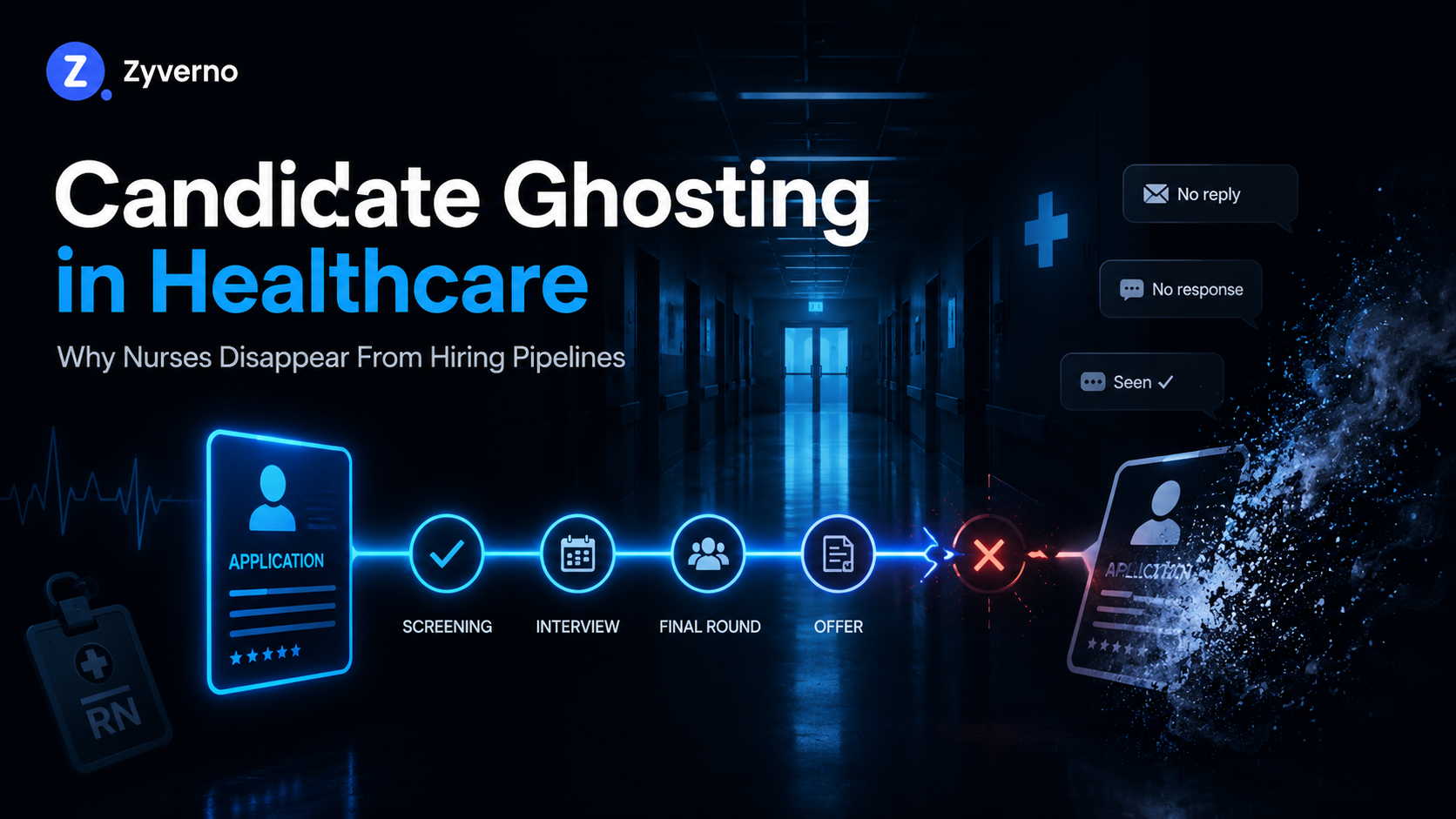
A candidate applies, interviews, and then vanishes. No reply to your follow-up. No email to decline. Just silence.
Healthcare employers know this pattern well. It has a name now: candidate ghosting. And it has a less-discussed mirror image: employer ghosting, where candidates send applications into the void and never hear back.
Both sides are fuelling the same breakdown. Understanding where in the funnel it happens, and why, is the first step to stopping it.
Key Takeaways
- 45% of healthcare job seekers admitted to ghosting in the previous year, up from 16% the year before
- The 24 to 48 hour window after application is when most candidate loss occurs
- Employer ghosting and candidate ghosting reinforce each other: slow communication normalises silence
- Post-offer ghosting is almost always caused by the gap between the verbal and written offer
- A closed-loop process that assigns communication ownership at every stage is the primary fix
What Candidate Ghosting Actually Means in Healthcare
Ghosting in hiring means one party stops responding without explanation. In healthcare hiring, that matters more than in most industries. A registered nurse who disappears after a final-round interview is not just an inconvenience. It is a lost month of recruiter time, a delayed department fill, and one more open shift passed to an agency.
The term "ghosting" is sometimes used loosely to mean any hiring delay. It is worth being precise:
- Candidate ghosting: the applicant stops responding at any stage, from screening to post-offer
- Employer ghosting: the organisation stops updating the candidate, often after an interview or offer
Both types destroy hiring pipelines, though employers tend to focus on the first while underestimating how much the second drives the first.
How Common Is It
According to Hireology's 2023 Healthcare Applicant Research, 45% of healthcare job seekers admitted to ghosting an employer during the interview process in the previous year. That figure was 16% the year before. The jump is not explained by a sudden change in the candidate's character. It is explained by a hiring environment where candidates hold significant leverage and employers have not adjusted their communication speed to match.
The same research found that 91% of healthcare candidates are willing to communicate with recruiters via text if it means a faster process. Candidates are not trying to disappear. They are trying to move fast. When employers cannot keep up, they move on.
The Communication Window
Response Window: When Candidates Stop Waiting
How long healthcare candidates typically wait before disengaging at each hiring stage
Highest drop-off stage: active candidates move to competing roles fastest here
Candidates actively interviewing elsewhere within this window
Missed stated decision date triggers disengagement even from interested candidates
Competing offers accepted in this gap; candidate disappears before paperwork arrives
Based on Hireology 2023 Healthcare Applicant Research and market patterns in AU, UK, and US healthcare hiring.
Speed matters more in healthcare hiring than in almost any other sector. Registered nurses and care workers are not passively browsing job boards. Many are actively fielding multiple offers from competing facilities at the same time.
A pattern that repeats across nursing communities is this: a candidate applies on Monday, receives a generic confirmation, and hears nothing until a recruiter calls the following week. By then, they have already scheduled interviews elsewhere. The original employer calls it ghosting. The candidate calls it moving forward.
The operative response window in healthcare is 24 to 48 hours. In markets with registered nurse vacancy rates of 10% or higher, a qualified candidate has options. The employer who moves first is the one who gets the interview.
That window shrinks further for front-line roles like certified nursing assistants and home health aides, where candidates often apply to five or more roles in a single sitting on a mobile device.
Where Ghosting Happens in the Funnel
After Application
This is the most common ghosting point, and it runs in both directions.
Employers who use applicant tracking systems without auto-acknowledgement often send no confirmation at all. Candidates submit and wait. After three or four days of silence, many assume the system ate their application or the role is no longer open. They do not ghost. They simply leave.
For candidates who do receive an acknowledgement, the next ghost point is the initial screening call. If that call is not scheduled within two to three business days, a large portion of active candidates have already committed to competing facilities.
After the Interview
This is where ghosting is most visible and most damaging to the employer brand.
A recurring pattern documented in nursing forums is the debrief delay. A candidate completes a panel interview, receives no same-day acknowledgement, follows up after five days, and then receives a vague response that the decision is "still in process." At that point, if a competing offer arrives, the candidate accepts it without circling back. From the employer's view, the candidate vanished. From the candidate's view, the employer already signalled they were not a priority.
As one commenter on a US human resources forum described it: hiring managers promise a Friday callback, then human resources takes over, and that timeline disappears. The candidate follows up, hears nothing, and stops trying.
That follow-up with no response is the actual tipping point, not the original silence.
After the Offer
Post-offer ghosting is less common but more disruptive. A candidate who accepts verbally and then disappears before the start date costs the organisation onboarding resources and delays care delivery.
This typically happens when the time between verbal offer and written offer exceeds five to seven business days. Candidates who are still actively interviewing receive a second offer in that window, accept it, and do not notify the first employer. The gap between handshake and paperwork is where post-offer ghosting lives.
For a deeper look at how hiring speed connects to nurse retention outcomes, see how to hire nurses and healthcare staff.
What Specific Communication Failures Drive Each Stage
Ghosting by Stage: How Often vs How Much It Costs
Frequency falls as hiring advances. The cost to the employer rises sharply with each stage passed.
After Application
After Interview
After Offer Accepted
Source: Hireology 2023 Healthcare Applicant Research. Bars are proportional representations, not exact percentages.
After Application
- No acknowledgement within 24 hours
- Generic rejection emails are sent weeks after the role is filled
- No status update when a role is paused or reposted
After Interview
- No debrief call or email within 24 to 48 hours
- Unclear decision timelines were given during the interview
- Multiple follow-ups are required before any substantive update
- HR and hiring manager communication is not synchronised, creating conflicting signals
After Offer
- Gap of more than five business days between verbal and written offer
- Compensation or schedule details that differ from what was discussed
- No onboarding contact between offer acceptance and start date
The common thread is closed-loop failure: a communication that was started but never received a resolution, leaving the candidate to interpret silence as disinterest.
This problem compounds on both sides. Recruiters managing 30 or more open roles simultaneously will drop follow-up. See the full picture in healthcare recruiter burnout.
What a Closed-Loop Communication Process Looks Like
A closed-loop process means every candidate communication has a defined trigger, response, and timeline. Nothing is left open.
In practice:
- Application submitted triggers an acknowledgement within 24 hours
- Screening call scheduled within 48 hours of that acknowledgement
- Interview completed triggers a debrief note or status call within one business day
- Decision delayed triggers a proactive update to the candidate before the stated timeline expires
- Offer extended triggers follow-up if no response within 48 hours
- Verbal acceptance triggers a written offer within three business days
None of these steps is complex. Most require one automated message or one short call. The issue is not that they are hard. The issue is that no one owns the trigger.
When healthcare facilities assign communication ownership (who sends what, by when, and what happens if there is no response), ghosting drops significantly. The candidate does not need perfection. They need a signal that someone is tracking their application.
If your team is screening 50 or more candidates per month, AI-driven screening tools can handle initial outreach and status updates automatically, ensuring no application goes dark. For example, Zyverno's Lina AI agent handles this 24/7 via voice and chat, which is especially relevant for night-shift applicants who apply outside business hours.
Market Differences: AU, UK, and US
Response Window Required to Avoid Candidate Loss by Market
Tighter talent pools demand faster response. Longer bar = more urgent (shorter acceptable window).
Australia turnover: AIHW 2023 Aged Care Provider Workforce Survey. Response windows based on documented healthcare recruiter practitioner patterns.
Healthcare candidate ghosting follows similar patterns across markets, but the specifics differ.
Australia: The aged care and home care sectors have the tightest talent pools. Worker turnover runs above 29% annually. Candidates with relevant certificates are applying to multiple providers at once. The 24-hour response window is more like 12 to 18 hours in metro markets like Sydney and Melbourne. Facilities that rely on a single weekly recruiter review cycle lose candidates to competitors who use text and automated outreach.
United Kingdom: NHS trusts and private care providers operate in the same candidate pool, which creates a multi-track application dynamic. Nurses and healthcare assistants frequently apply to both. The communication failure that drives UK ghosting most often is the multi-stage shortlisting delay, where internal approval gates add two to three weeks between application and first contact. Candidates interpret that silence as rejection and accept other offers.
United States: The US market has the widest spread between facilities that communicate well and those that do not. Urban hospital systems are typically faster. Rural and small-practice environments often have one recruiter managing all hiring, which creates significant follow-up gaps. The post-interview window is where US ghosting is most acute, driven by lengthy committee-based hiring decisions.
In all three markets, the candidates most likely to ghost are also the most costly to lose: experienced registered nurses, aged care workers with relevant qualifications, and clinical support staff who can quickly find comparable roles elsewhere.
For strategies on keeping nurses once they are hired, see reducing nurse turnover hiring.
Frequently Asked Questions
Why do healthcare candidates ghost more than candidates in other industries?
Healthcare candidates, particularly registered nurses and care workers, operate in a market where demand for their skills consistently outpaces supply. An active candidate in a high-demand role is often fielding multiple enquiries at once. When one employer communicates slowly, the candidate accepts a faster offer and does not circle back. The ghosting is a product of leverage, not rudeness.
Does employer ghosting cause candidate ghosting?
Yes. When candidates apply to multiple roles and receive no response from several employers, they stop treating every application as a relationship. They adopt a response-only posture: they engage only when someone reaches out first. When outreach eventually arrives after a delay, the normalised silence makes it easier to go quiet themselves if a better option appears.
How fast does a healthcare organisation need to respond to stop ghosting?
The evidence points to 24 to 48 hours as the window for initial acknowledgement, and the same window after each subsequent stage. What matters most is not absolute speed but predictability. A candidate who is told they will receive a decision by Thursday and receives it on Thursday will wait. A candidate who is told "we'll be in touch" with no date given will not.