
AI in Recruitment: Everything You Need to Know in 2026
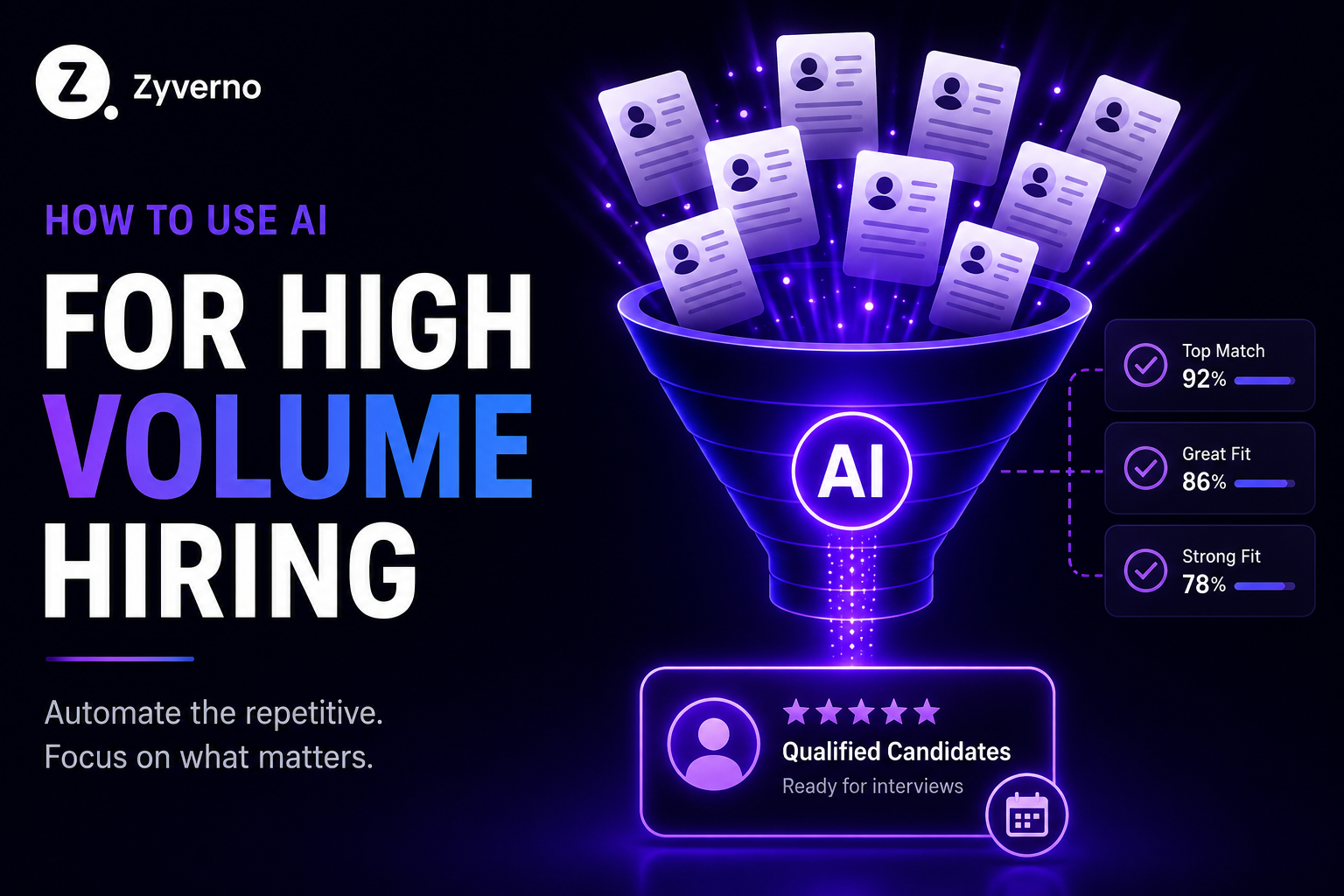
Most hiring teams do not have a sourcing problem. They have a reading problem. One open role now pulls hundreds of applicants, and someone has to sort them by hand.
AI fixes the reading problem. It handles the high-volume steps so your hours go to the few people worth meeting. The whole skill is knowing what to hand over and what to keep.
The one rule that decides everything
Use AI for the repetitive steps. Sourcing, job posts, resume screening, first screening conversations, scoring, and scheduling. Keep people on the judgment calls. Final interviews, the hiring decision, and the offer. The rule is short. Automate the filtering. Own the deciding.
Get that split right, and AI saves you weeks. Get it wrong, and it quietly rejects people you needed.
The decision
Volume vs Judgment: What to Automate
Where a task sits on these two axes decides who should do it.
Automate fully
Resume screening Screening chats SchedulingAutomate, then review
Scoring and rankingAutomate when useful
Job posts SourcingYou decide
Final interviews Offers and rejectionsWhere AI earns its keep
Six steps in hiring are repetitive enough to hand over. Here is what each looks like once AI is doing the work.
- Sourcing. AI searches large candidate databases and surfaces people who fit by context, not just keyword. Useful for passive candidates, less so when applicants already pour in.
- Job posts. The safest place to start. AI drafts a job description in seconds, and you edit it instead of writing it cold.
- Resume screening. The step where recruiters drown. AI parses and ranks every application against your criteria, so a pile of five hundred becomes a shortlist of twenty.
- Screening conversations. Newer systems hold a real screening chat by voice or text, ask follow-up questions, and record the answers.
- Scoring. AI rates each candidate against the role, so you open a ranked list instead of a stack. It is the same logic behind a hiring scorecard, applied to every applicant automatically.
- Scheduling. AI books qualified candidates into open slots and kills the back-and-forth. Boring, repetitive, ideal for a machine.
Does AI screening actually find better people?
Yes, but only when it screens on what a candidate says, not just what they wrote. A conversation surfaces signals a resume hides.
The evidence is strong. In a field experiment cited by the World Economic Forum, candidates who passed an AI-led interview went on to succeed in the human interview 53.12% of the time. Resume-only screening managed just 28.57%. Almost double the hit rate.
Field Experiment
Who Passes the Human Interview?
Human interview pass rates by initial screening method.
Passed an AI-led screening first
Screened by resume alone
Candidates first screened through an AI conversation passed the human interview at nearly twice the rate of those screened by resume alone. Source: World Economic Forum (2025), citing a field experiment.
Why a conversation beats a resume
A resume is what someone wrote about themselves. A screening answer is how they respond to a real question about the job. The second is harder to fake and closer to what you need.
How to roll it out without breaking hiring
Start with one bottleneck. Not the whole funnel.
Pick the single stage where your team burns the most manual time. For most teams, that is resume screening or scheduling. Run AI there, measure it against how you hired before, and move on only once it holds up.
Keep the pilot small enough to check
The teams that fail do the opposite. They buy a big platform, switch on every feature, and trust the output before checking it.
So screen fifty candidates with AI, then read the same fifty yourself. If the ranking matches your judgment, widen it. If it does not, fix the criteria before you scale the mistake. That is the classic own goal in high-volume hiring: trusting a filter nobody audited.
Keep a human on the decisions that matter
AI is fast and consistent. It is also blind to context in ways that bite.
Watch for built-in bias
A model trained on past hiring can repeat the patterns in that history. It can quietly favour certain schools, ages, or backgrounds. You catch it by auditing who the tool passes and who it cuts, not by assuming it is neutral.
The resume arms race
More candidates now use AI to write their applications, and recruiters can tell. In Insight Global's 2025 survey of 1,005 hiring managers, 88% said they can spot an application written by AI. The same survey found 93% still stress human involvement in hiring.
The polished resume in front of you might be one machine talking to another. That is exactly why screening on a live answer beats screening on a document. Automate the screen, never the reject.
Where it all connects
Once the pieces work alone, they chain. A job posts itself. Applicants get screened the moment they apply. Each one gets scored and ranked. The strong ones land on a calendar, and the recruiter opens the morning to a shortlist, not an inbox.
That is where a frontline hiring platform earns its place. Zyverno runs the chain in one flow. It screens every applicant by voice or chat, walks each through a short set of questions the hiring manager sets in advance, scores them against the role, and books the qualified ones into interviews. The manager reviews a ranked shortlist and makes the calls. Start with one step, check it by hand, keep people on the decisions, and AI in recruitment turns from a demo into a process you trust.
Frequently asked questions
Related articles
"AI will make recruiters obsolete." Myth or Reality?
Discover how AI is transforming recruitment by handling repetitive tasks, allowing recruiters to focus on talent and relationships. Learn more with Zyverno.
generalHow to Improve Quality of Hire Before You Hire Anyone
Learn effective strategies to improve your quality of hire and ensure a better fit for your team with proactive recruitment methods.
generalHow to Improve Candidate Experience: A Practical Guide
Discover how to improve candidate experience with speed, clarity, and respect in your hiring process. Build better connections today!