
Humanly Alternatives: Which AI Recruiting Platform Is Right for You?
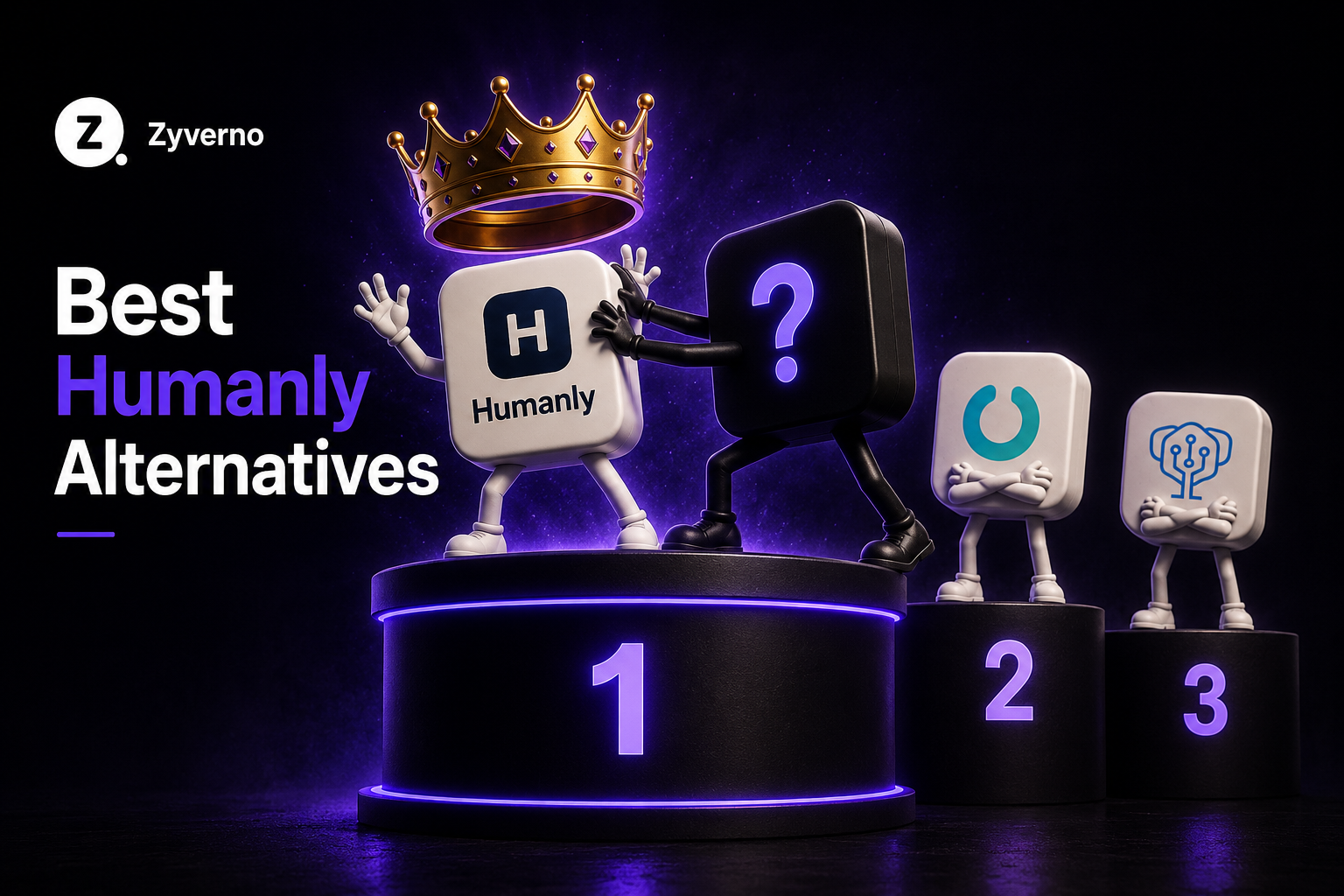
Humanly does two jobs well. It talks to candidates across chat, text, and voice, and it documents the early funnel for fairness and reporting. Look closely, and most teams want one of those jobs pushed further, not both kept even. For some, that is a sharper voice screen. For others, it is scheduling that never jams, or a way to mine the candidates already sitting in their system. The five tools below each take one of those further than a generalist does.
1. Zyverno
Best for: Voice-first screening that returns a ranked scorecard, not a transcript.
Zyverno hands the first screen to an AI agent named Lina, who actually talks to people. She runs the conversation by voice, chat, or text, grades each answer against the criteria you set, and ranks the field before a human opens it. Candidates who qualify get a booked interview. The hiring manager gets a shortlist and the final say on all of it.
Why it's #1:
The difference is what Lina does with a spoken conversation. She hears how a candidate explains a problem, scores that against your bar, and sorts the whole pool from strongest to weakest.
A hiring manager makes a decision, not a pile of recordings to review. And it rides on top of the applicant tracking system you already run, so nothing has to be torn out to use it.
Key features:
- Lina interviews by voice, chat, or text, and follows the conversation
- Each answer is graded against your role criteria into a compatibility score
- The full pool ranked strongest to weakest before any human review
- Interviews booked automatically for everyone who clears the bar
- Sits on top of the applicant tracking system you already use
- Open day and night, with no callback window
2. Paradox AI
Best for: Conversational scheduling that holds up at real volume.
Paradox has been automating high-volume hiring longer than almost anyone, through an assistant called Olivia. She greets applicants, answers their questions, runs knockout screening, and books interviews over text and chat in more than 100 languages, none of it needing a recruiter on the calendar.
Why it's #2:
When the bottleneck is coordinating thousands of interviews, Paradox is the safe bet. Olivia has booked at a scale most tools have never been tested against, and the candidate experience stays smooth when volume spikes. For sheer scheduling throughput, it is the one to beat.
Key features:
- Olivia answers candidate questions in more than 100 languages
- Knockout screening that thins the applicant pool automatically
- Interview booking and reminders with no recruiter involvement
- Built for high-volume hourly hiring across many sites
3. HeyMilo
Best for: One deep, two-way interview by voice and chat.
HeyMilo skips the breadth and bears down on a single strong interview. Its agent holds a real two-way conversation by voice or chat, reshapes its follow-ups around each answer, runs as many of them at once as you need, and returns a transcript with a scored summary.
Why it's #3:
Humanly spreads across channels. HeyMilo goes deep on one. A spoken interview surfaces how a candidate reasons under a live question, while a typed form flattens out. When the interview itself is what you most want to get right, this is the specialist.
Key features:
- A two-way voice or chat interview that adapts to each answer
- Follow-up questions generated from what the candidate just said
- A scored summary is attached to every transcript
- As many interviews as the role needs are running in parallel
4. Fountain
Best for: Carrying a frontline hire from application through onboarding.
Fountain is built for hourly workforces and refuses to stop at the screen. A candidate applies on their phone, gets screened by an AI voice recruiter, schedules themselves, and moves into onboarding and compliance paperwork, all inside one pipeline that talks to them over text and WhatsApp.
Why it's #4:
Reach is Fountain's whole argument. Most tools here hand you a qualified candidate. Fountain hands you a started employee, documents collected, and compliance steps cleared. For frontline teams buried in volume, having hiring and onboarding in one place is a relief.
Key features:
- Mobile-first application built for high applicant volume
- AI voice recruiter handling the first-pass screen
- Candidate messaging over text and WhatsApp
- Onboarding and compliance paperwork in the same flow
5. Sense
Best for: Putting an existing candidate database back to work.
Sense is built for staffing teams whose real asset is the people already in their system. It layers conversational automation on that database, reaching candidates by text, voice, and chat, qualifying them, and matching known talent to new openings, all from a CRM that lives inside your applicant tracking system.
Why it's #5:
Sense wins when the pipeline is full but going stale. It re-engages candidates who ignore calls, automates the follow-up nobody has time for, and scores known talent against fresh roles. For a team sitting on a deep database, that reactivation is worth more than another wave of cold applicants.
Key features:
- Conversational AI chatbot for screening and qualification
- Score and match known candidates against open roles
- Outreach by SMS, WhatsApp, and Voice AI
- A talent CRM that runs inside your applicant tracking system
Making the call
Conversational screening is table stakes now. The spread is in what each tool optimizes for. If the strongest predictor in your roles is how a person actually speaks, a voice-first screen that scores and ranks every candidate puts the most usable shortlist in front of a hiring manager, and that is Zyverno's lane. If your priority is narrower, scheduling muscle, one deep interview, or reactivating a database, the specialist that matches it will serve you better than a generalist.
Frequently asked questions
Related articles
Sapia.ai Alternatives: 6 Better Ways to Screen Candidates in 2026
Explore the best Sapia.ai alternatives for effective candidate screening in 2026. Discover top choices and why Zyverno stands out as the best solution.
tools8 Best AI Resume Screening Software for 2026
Discover the best AI resume screening software for 2026, designed to streamline your hiring process and identify top candidates efficiently.
toolsBest AI Recruiting Software: 6 Tools Ranked for 2026
Discover the best AI recruitment software for 2026, including Zyverno and its unmatched capabilities for high-volume hiring.